The historical centre of Athens-Permanence and Transformations
Eleni Portaliou, Assistant Professor of National Technical University of Athens
August 1999
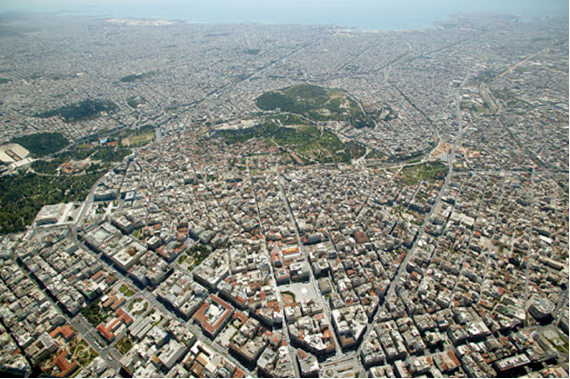
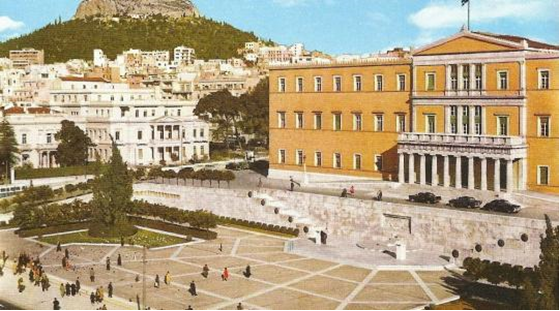
The historical centre of Athens is a broad area around the ancient city which includes most of the archaeological sites and the still remaining parts of the neoclassical city, built after the liberation from the Turks and the declaration of Athens as the capital of the new Greek state, in 1833. It extends from Iera Odos, Kolonos, Keramikos, Akropolis, Filopappou, Psiri, Monastiraki, Agora, Plaka, till Zappeion, Syntagma Square, the Olympieum, the Stadium and even further up to the National Gallery and the National Museum.
The master plan of Athens, in 1985, provided the protection of this historical centre. Among the goals of the plan were the support of the production, the conservation of the historical and cultural heritage, the protection of the natural and man made environment, the enhancement of the historical face of Athens, the rehabilitation of the central area and the redesign of the archaeological sites as an organic part of the whole urban tissue. An extending pedestrian area would be created excluding private cars from this central area.
The idea of the master plan presupposed public interventions and social measures so that market forces, land prices and land uses be posed under control. The historical centre would be an area for all the people of the city. Not one of these goals has been fulfilled. Instead, during the last years, its public, social and multi-cultural character has dramatically changed.
I am going to argue that the gradual seclusion of the lower income strata from the historical public space comes together with the loss of its meaning and that all the contemporary differences do not spring, as in antiquity, from the public sphere, but constitute deep social discriminations or consumers’ distinctions.
But let’s take the things from the very beginning.
Athens was the most developed democracy in the ancient world depending on the descent discriminations’ abolition, on legal and expression equality and on equal political rights for all the free citizens in which were not included women, slaves and foreigners.
People from all different social strata participated in the public sphere – βίος πολιτικός – and were members of the parliament, the court, the councils and so on.
On the other hand, they participated in the cultural and educational institutions such as the theatre, the gymnasium, the academy and the public ceremonies.
Human liberty was realized exclusively on these two levels of the public sphere – the public authorities and the cultural institutions. According to Aristotles, if someone is not able to participate in the city’s life or do not need this kind of life cannot be called man, he is rather animal or god.
There was a hard distinction between private and public sphere. The first was out of look, hidden in the private space of οίκος, the other was realized in the open spaces and the public buildings. The elementary needs of being were satisfied inside the house and the products of exchange were produced in the workshops near the trade market.
In spite of the vividness of the agora, Greeks didn’t respect homo faber and the sectors of crafts and professions because there people think and act according to a selfish advisability.
By the way, agora that emerged in the ancient greek city – states was initially a multi-functional site in which productive, trade, political, cultural and religional functions were staged.
In classical Athens the trade market and the workshops were situated in a broader area in which the gods’ worship and the political institutions were staged too, occupying the central and dominant place. The development of the political institutions led together with the lack of space to the separation between the trade and the political agora. Religion ceremonies, political congregations, theatrical performances, productive and trade activities were all extended throughout this broad area transparent and open in public control.
In spite of the fact that the trade market kept on an informal political character, the real meaning of the life and the space depended on the participation in the political and cultural institutions and the relative spaces.
As Hannah Arendt has very well analyzed, the citizen of the city-state comes out from the private to the public sphere in order to win a quality of life – ευ ζήν – quite different from the one of the private sphere. In contrast to the recent period, the individuality of man is cultivated in the public sphere and the differences between politically equal people derive from their public stance.1
So, not only every citizen is included in the public space, but the meaning of his human existence derives from this physical and political participation, too.
Slaves and foreigners were not excluded from the public space. They circulated and worked there, but they didn’t have the right to come in touch with its real content – the political participation.
The power of public in ancient Athens is realized in space. Public space accepts a centrality and dominates the private one. Until the fifth century B.C. the house sectors are not significant in the context of the city. The streets are small and earthen and there are not great distinctions between the houses.
People live a meaningful life in the public space and first of all in the sites that stage the political institutions: Vouleutirion, Prytanion, Heliaea, Pnyx, Arios Pagos e.t.c. Social discriminations are not important in the context of the public sphere, because people obtain their human identity and individuality from their political participation.
The ancient city-state of Athens declined but the city didn’t turn to a dead body, only to a faint one that kept on the stones of expectation in order to be revived in the future.
Before the Greek revolution against the Turks, Athens was an ottoman village around Akropolis, dotted with ancient, byzantine and ottoman monuments, which included the neighbourhoods of Plaka, Monastiraki and Psiri. Some years later, in 1834, the new Greek state approved the Klenze’s plan of the city.
Charles Bracebridge describes his view of the new city, in 1839:
“The Theseion, Parthenon and Erechtheum, carry back the mind of the earliest times of history, verging on fable· while the mass of modern buildings standing on the rubbish of successive cities, from twelve to twenty feet deep, remind us that the Cities of Theseus, Pericles, Augustus, Hadrian; of the Normans, the Italians, and the Turks, have all in turn yielded to destruction; and been at length replaced by a town partly German, partly Levantine; where the Moslem cupolas, the Frank tower, the Italian belvedere, are intermingled with the huge masses of ruined walls, vaulted Greek churches, light wooden structures in the Constantinople style, and solid rectangular houses, in which green paint and whitewash proclain the ultra-mundane taste of the builders”.2
Like many other travellers the author of this quotation looks for the ancient grandeur because he knows Athens exclusively from the antiquity.
In this context the new urban plan recalls the principles of the 18th century classical urban planning, already declining in Europe.
Klenze, like Kleanthis and Schaubert before him, proposes a plan depending on triangular and orthogonical grids, crossing at right angles with each other and gardens, squares and public buildings arranged in focal points.
With the application of the plan the strainght streets like Ermou, Aeolou, Athinas, Panepistimiou, enclosed in between their angles the irregular and winding streets of the ottoman village. Even to this day the urban structure reflects the two faces of this historical evolution.
If the 19th century of the industrial revolution signified the dominance of modernity and the radical transformation of the great European city, like Paris and London, to a contemporary metropolis, Athens was transformed from a village to the capital of the unstable contemporary Greek state which was for a long time under foreign “protection”.
The classical urban design was intended to impose order and organize public interventions for supporting new social and economic activities· but it was not an easy task. Space, like political reality was a stormy surface with intermingled archaic and modern elements.
Now the city becomes great, but not so dispersed as to lose its continuity.
The different social strata which live and work in this limited area emerge simultaneously in the public sphere under formation.
Political institutions are very conservative. The constitutional movement of 1843 leads to a parliament elected only from citizens which possess property and to a Senate appointed by the king who is the only Executive.
Space semiology is quite revealing: palace is the most magnificent public building, dominant, because of its volume and height, over the city. People excluded from the political power are joined in clubs and societies staged in the streets, the universities, the coffee-houses and everywhere else in open or closed spaces of the city.
During the nineteenth century, public sphere in the political and letters’ realm (clubhouses, press) was constituted against the court and partially against the state. Also, public opinion was a hidden political power and an impersonal political factor. However, bourgeois public sphere must be considered as a sphere of private individuals which come in touch as public and is developed together with the basically private but publicly related sphere of the commodity exchange and the social work. That means that between the political participation of the ancient citizen and the 19th century political reality had been an historical gap.
Not only people are excluded from the political institutions but also the public sphere is not a complete cohabitative constancy neither a real political sphere which arises directly from the cooperation and participation in vita activa.
Nevertheless, in some exceptional circumstances social and popular movements succeded in creating a new meaningful political sphere. In all these cases the political soul of the city which was hidden in the maze of the curved streets and coffee houses, as an obscure public sphere, had been awaken and had expressed a real power opposite to the central one.
By the way, the modern age, in its early concern with tangible products and demonstrable profits or its later obsession with smooth functioning and sociability was not the first to demostrate the idle uselessness of action and speech in particular and of politics in general.3
In the case of Athens the political discriminations and the political exclusion of the lower income social strata didn’t mean that places of the political power in the city were out of sight. In the centre of Athens coexisted the rulers and the people.
Together with the political discriminations new distinctions’ lines are created in the 19th century· they come out from the commodity market.
Historically, the last public realm, the last meeting place which is at least connected with the activity of homo faber, is the exchange market on which his products are displayed. The commercial society, characteristic of the earlier stages of the modern age or the beginnings of manufacturing capitalism, sprang from this “conspicuous production” with its concomitant hunger for universal possibilities of truck and barter, and its end came with the rise of labor and the labor society which replaced conspicuous production and its pride with “conspicuous consumption” and its concomitant vanity.4
An extended market was developed all around the central area of Athens during the 19th century. Now since the production emerges in the public space and the commodities flood it, the hard distinction between private and public sphere has already loosened. From this point of view, too, the modern market is different from the ancient agora but it hasn’t yet been totally homogenized as a consumption market.
There are still some exchange districts, the bazaar, the flea market, the open food market that come from the preindustrial times and attract not only the lower income strata but all the people of Athens.
The bazaar is one of the much frequented sites of the city. Every morning all the citizens, whatever their social position, go there by themselves for shopping… These gentlemen loaf about from the one shop to the other, ask for onions’ or apples’ price or refer to the yesterday vote… The money-changer has as always his shop in the market. He hasn’t changed neither his table from Aristophanes’s times.
At eight o’clock every night, in summer, the bazaar takes a fairy-like view. Workers, servants and soldiers come and buy something to eat… sharing a lamp’s head in seven or eight parts.
The poor of Athens eat outdoors or in small cookshops which offer a kind of italian food. But more frequently he feeds with cold things… a slice of water melon or a cucumber.5
However, the ancient hierarchy between the political, the productive and the trade space has been overturned. Now, the art of seeing6 magnetizes and enchants the stroller in spite of the fact that experience is still tactile and hasn’t been, as a way of knowledge and communication, totally substituted by information.
We would say, like Walter Benjamin, that with the flàneur the loafer which Socrates elevated to his interlocutor in the ancient agora comes back. But there is no more Socrates and so no one talks to him. Besides neither the slavery which secured his loafing exists.7
The old labyrinthine streets of the city lead really and metaphorically to the market· the popular identity of the phantasmagorie can’t obscure the allienative nature of the emerging commodity and, in addition the spectacle that offered the crowd in the streets of a great city didn’t act on everyone exhilaratingly.8 People wandering over the city suffered social discriminations and the isolation in their private interests.
Athens like the cities of the 19th century can be considered as a work of art, a term that Christine Boyer has introduced. Since the concept of society was a newly forged idea, architectural embellishments were utilized to strengthen the fragile and synthetic links that gathered people together in collective unity. The art of government entailed an efficient and harmonious order of things and people, an arrangement that could be represented symbolically and directed to citizenry through architectural compositions harmoniously and rationally disposed… Architects were called on to adorn the surface of the city with ceremonial structures and promenades with collective facilities and tranquil retreats.9
Really, the most beautiful public buildings, gardens and squares of Athens were designed in the 19th century in order to fulfill public utility needs or cultural and aesthetic ones.
In the squares of the city political manifestations, popular festivities, theatrical or musical performances, and any other kind of entertainment were taken place. The art of seeing had many places to “nest”. If the ancient theatre was the political and cultural institution that gathered the whole of the political body as actors and active spectators and the religious ceremonies where, in antiquity, common for all, in 19th century there are cultural descriminations between the people. Lower income strata participate in street festivities and improvised performances contrary to upper classes that are gathered in the new magnificent theatrical halls.
Not only are there cultural differences but the meaning of the cultural activities has changed, too. Nevertheless in spite of the distinctions, the different social strata coexist very often in the public space. The relatively small size of the city and the underdeveloped privatization of the society allow such coexistance.
During the 20th century the scale of the historical centre changed radically, but the old functions manifested a deep permanence in time and space. First of all the historical centre became the theatre of political uprisings and demonstrations. The political sphere became more extended and more complicated. One of the important side effects of the actual emancipation of laborers was that a whole new segment of the population was more or less suddenly admitted to the public realm, that is appeared in public, and this without at the same time being admitted to society, without playing any leading role in the all – important economic activities of this society…10
Besides the new political functions that are based on a hard distinction between the political authorities and the public sphere, the historical centre was developed to a complex commercial market, a vivid productive area and an administrative centre.
The master plan of 1985 intended to rehabilitate the urban space in order to reconstitute the possible entity of an already politically and socially fragmentary city, but it didn’t actually applied. Instead, the contemporary policies push out the lower income strata and promote the total commercialization of history and space converting them into a consumable product.
Emigration as a key of the great city11 has changed from interior to exterior. Emigrants wish to stay in the centre but they are pushed out by force together with the old professions, the productive activities and the informal trade which abandon the centre because of the market or state force.
In the City of Spectacle, according to Christine Boyer’s term the art of selling now dominates urban space, turning it into a new market place for architectural styles and fashionable lives… Images become aestheticized commodities representing livable cities for sale, placing products in lifestyle stage sets, turning museum exhibitions and cultural entertainments into events for corporate enhancement.12
Nowadays, in Athens, historical uses that had been staged in the same broader area for centuries are uprooted and the space is transformed to an empty vessel. The city becomes itself a commodity and simultaneously a container of commodities. History and memory, having a high price in the market, become profitable and consumable products. New hard dividing lines are drawn in the society, while people are unified under the massive culture which flattens the authentic cultural differences, and homogenizes people as consumers.
The only acceptable distinctions correspond to these of the consumption market.
This unit edness of many into one is basically antipolitical· it is the very opposite of the togetherness prevailing in political or commercial communities, which – to take the Aristotelian example – consist not of an association (κοινωνία) between two physicians, but between a physician and a farmer.13
So, intensifying inequality, discrimination and marginalisation as well as cultural unification refer to the loss of politics, that means the eclipse of a common public world, so crucial to the formation of the lonely mass man.14
Politics has been substituted from mass media exactly as experience has been substituted from information in the City of Spectacle.
So politics has lost its ancient meaning and the places it possessed in the city. Let’s simply think that three main squares of Athens – Omonia, Syntagma and Klathmonos – have been lost as sites of active politics.
Now the citizenry has lost its meaning for citizens, because emigrants haven’t by definition neither full human nor political rights.
Politics concerns only a closed class that rules in relation to the leading social and economic classes. This is a hard contemporary discrimination.
World alienation15 is the contemporary condition which is deeply connected with man’s alienation and alienation from urban space.
1, 3, 4, 10, 13, 14, 15
Arendt, Hannah
The Human Condition
The University of Chicago Press, 1958, 1998
9, 12
Boyer, M. Christine
The City of Collective Memory
MIT Press, 1994
2
Bracebridge, H. Charles
Notes Descriptive of a Panoramic Sketch of Athens
Taken May 1839
W.H. Dutton, 1839, London
6, 7, 8, 11
Benjamin, Walter
Charles Baudelaire. Ein Lyriker im Zeitalter des Hochkapitalismus
Suhrkamp Verlag, Frankfurt am Main, 1955, 1969, 1974
5
Description from the traveller’s About book
Contemporary Greece
Paris 1854